| ||
| ||
|
The lede
Netflix grew 12%, its slowest in three years, and made money its priority. Comscore counted where the ads get seen, and streaming has 22.3%.
The Wall Street Journal’s Jessica Toonkel reports Netflix’s third-quarter revenue rose 12% to $12.9 billion, its weakest quarterly growth in three years, while net income jumped roughly 44% to $3.66 billion. The Ankler’s Sean McNulty reports the company matched or beat its forecasts and talked up a “business flywheel” on the call. The weak spoke is the one it needs most: AdExchanger’s Alyssa Boyle reports ad revenue grew more than 80% and still fell short of the goal to double it again this year, and The Verge’s Emma Roth reports the shareholder letter now names monetization a top priority. The response was tooling. Adweek’s Mark Mwachiro reports a Netflix Pixel with more than 20 lower-funnel conversion events, and AdExchanger reports The Trade Desk arriving as a programmatic DSP next month, announced the same morning as the earnings. The FT reports a hit drought stoking doubts about a valuation near $300 billion; CNBC reports Needham’s Laura Martin calling the sell-off overdone on a projected $3 billion in ad revenue. The count arrived the same week. Digiday’s Tim Peterson reports Comscore’s new monthly Score Report ranks TV and streaming companies by their share of the audience’s ad exposure time rather than viewing time, with YouTube and Tubi on top among the streamers, and Comscore’s own numbers give broadcast 43.2% of that time, cable 34.5% and streaming 22.3%. Nielsen reports total TV usage fell 4.4% in August, and TheWrap’s Lucas Manfredi reports YouTube’s share of TV viewing hit a record 15.8%. AdExchanger reports J.P. Morgan’s Eric Menell and Bank of America’s Jessica Reif Ehrlich telling NAB Show that streaming underdelivers against linear and ad revenue now decides whether a platform is profitable, while eMarketer’s Marisa Jones reports FAST audiences growing faster than the money committed to them. Next in Media’s Mike Shields reports Roku, Netflix, Comcast and DIRECTV each building a conversion API to copy the loop Meta and Google already have, with OpenAP pushing nine media companies toward one standard. And MediaPost’s Joe Mandese reports the Media Rating Council revoking Nielsen’s PPM accreditation in four radio markets and denying it in 18 more. Everyone selling ads this week was selling proof. Adweek’s Mitchell Parton reports Target’s Roundel admitting only 8% of its advertisers use incrementality as their primary metric, and eMarketer’s Grace Harmon reports Walmart betting on measurement upgrades to close on Amazon. AdExchanger’s Joanna Gerber reports OpenAI taking ChatGPT Ads to 26 more countries and claiming more than 100,000 advertisers since launch, while the bigger budgets wait on measurement, and AdExchanger reports the ad units losing their box and their “Sponsored” label along the way. The agencies that hold the data had the quarter: Digiday’s Michael Bürgi reports Omnicom’s organic growth at 7.2%, and Adweek’s Christopher Cicchiello reports Omnicom taking Coca-Cola’s North America media while WPP keeps the global account. The Media Leader’s Charli West reports IAB UK forecasting UK creator spend at £1.2 billion in 2026, with the pressure to prove performance arriving alongside it. What it costs you: a streamer whose growth slowed handed you a pixel, and a currency arrived that counts the ad break instead of the audience. Take both. In the upfront, ask each streamer for its share of ad exposure time, not its share of viewing; the gap between the two is a published number now, and it is the seller’s job to explain it. | ||
One big story | ||
 | ||
|
16 reports · 11 outlets · October 16 – 23
Netflix beat its quarter, grew its slowest in three years, and handed advertisers a pixel.
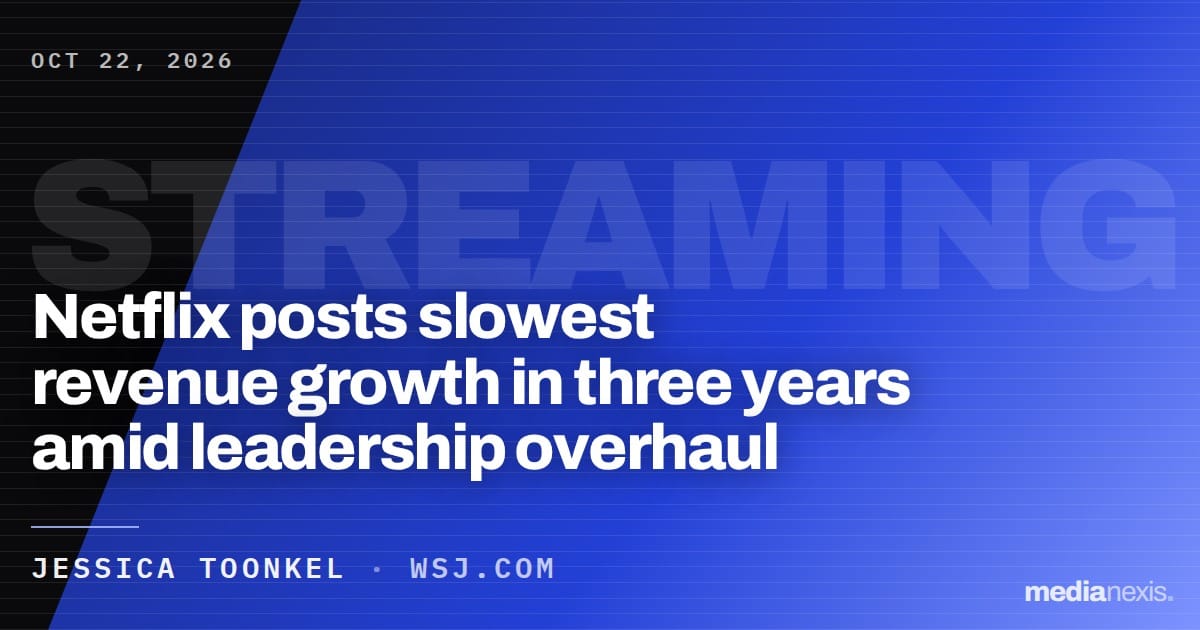
The quarter was fine and the growth was not. The Wall Street Journal’s Jessica Toonkel reports revenue up 12% to $12.9 billion, the weakest rate in three years, with net income up roughly 44% to $3.66 billion, and The Ankler’s Sean McNulty reports Netflix matched or beat its own forecasts and described a “business flywheel.” TheWrap’s Roger Cheng reports the call came after the biggest layoffs in four years, the exits of Bela Bajaria and Dan Lin, and a stock down more than 40% in twelve months. The Verge’s Emma Roth reports the shareholder letter naming monetization a top priority, next to entertainment value and new technology, and AdExchanger’s Alyssa Boyle reports why: ad revenue grew more than 80% and missed the goal of doubling again. So the week’s launches were for buyers, not viewers. Adweek’s Mark Mwachiro reports an enhanced Conversion API and a Netflix Pixel with more than 20 lower-funnel conversion events, and AdExchanger reports The Trade Desk joining as a DSP next month, announced the morning of the earnings. The prescriptions came from outside. MediaPost’s Wayne Friedman argues the fix is franchise IP, bought through a studio like Lionsgate or Sony; The Ankler’s Richard Rushfield sent Peter Rice a memo to kill binge-release and empower producers; Media War & Peace’s Evan Shapiro calls the company “a digital reboot of CBS.” CNBC’s Sarah Whitten reports 30 theatrical releases planned for 2027, including a 49-day exclusive window for “Narnia,” while Netflix insists streaming comes first. CNBC also reports Needham’s Laura Martin calling the sell-off overdone on a projected $3 billion in high-margin ad revenue, and the FT reports a hit drought stoking doubts about a valuation near $300 billion. Last week the cuts were the story. This week the company said what they were for: monetization, and the tools to prove it. OCT 16 · WALL STREET JOURNAL Roughly 1,000 jobs, the biggest cuts since 2022
OCT 16 · VARIETY Bajaria out after 10 years, Rice in
OCT 19 · MEDIAPOST The shakeup starts the M&A talk
OCT 19 · MEDIA WAR & PEACE Shapiro: a digital reboot of CBS
OCT 21 · THEWRAP Into earnings down more than 40% in a year
OCT 21 · CNBC Needham: $3 billion in ad revenue is the upside
OCT 21 · MEDIAPOST Friedman: buy a studio for the franchises
OCT 21 · THE ANKLER Rushfield’s memo to Rice: kill the binge
OCT 21 · THE VERGE Monetization named a top priority
OCT 21 · ADWEEK A pixel with more than 20 conversion events
OCT 22 · THE ANKLER Targets met, a flywheel claimed
OCT 22 · ADEXCHANGER Ad revenue up more than 80%, short of doubling
OCT 22 · CNBC 30 theatrical releases in 2027, a 49-day Narnia window
OCT 23 · WALL STREET JOURNAL Revenue up 12% to $12.9 billion, the slowest in three years
OCT 23 · FT A hit drought against $300 billion
OCT 23 · ADEXCHANGER The Trade Desk as a DSP next month
| ||
Six from the desk | ||
|
Measurement
MediaPost’s Joe Mandese reports the Media Rating Council revoked Nielsen’s PPM accreditation in Baltimore, Jacksonville, Philadelphia and Pittsburgh and denied it for 18 markets under review, including New York, Boston and Washington DC. In 22 radio markets the currency now trades without the auditor’s stamp, in the same month the industry is challenging Nielsen’s pay-to-report model.
Streaming
The Ankler’s Ashley Cullins reports Reese Witherspoon, with Mediawan, is buying back Hello Sunshine for less than 10 percent of the $900 million valuation Blackstone-backed Candle Media paid in 2021, and that the private equity money left over from the star-shingle boom is heading to digital creators instead. The boom has a closing price now.
Creators
Variety’s Cynthia Littleton reports Comscore’s Aaron Doades saying on the “Strictly Business” podcast that Jesser topped the unique reach of 14 live NBA games in March 2026, with 99% of his viewers not watching those games. That is not a reach number. It is an incrementality number, and it is the one a sports buyer cannot get from the games.
Ad-tech
AdExchanger reports ChatGPT’s ad units have gone through four iterations, dropping the darkened background and the “Sponsored” label until an ad reads as plain text inside the answer. Ad Age’s Garett Sloane reports the image ads start at a $300,000 minimum and $40 CPMs. The disclosure got lighter as the price got heavier.
Agencies
Adweek’s Christopher Cicchiello reports WPP retained Coca-Cola’s global media account while Omnicom won the North American business, after two separate competitive reviews. One of the world’s largest media budgets now has a rival inside it, in the quarter Omnicom grew 7.2%.
Retail media
Adweek’s Mitchell Parton reports Roundel’s Shawn McGahee telling advertisers at a New York event that only 8% of the network’s advertisers use incrementality as their primary performance metric. The networks spent two years selling proof. The buyers are still buying last touch.
| ||
The rest of the week | ||
|
Measurement and ad-tech
an off-the-shelf MMM found 75% where a custom build found under 1% · ChatGPT links dropped their UTM tags · search fell to 12% of North American pageviews · Coke’s AI ad scored 101 on attention · Clear Channel hired Wade Davis and John Halley · iSpot’s MLB count lost its regional sports networks · duplication across CTV apps is capping reach · young adults aren’t skipping TV ads · Wells Fargo’s Martin and Short won likes, not intent · CNN was cable news’ only across-the-board gainer · Comscore wants linear off age and gender · ChatGPT image ads start at $300,000 · an LLM orchestrator runs ChatGPT’s auction · custom audiences need 25,000 matched users · telehealth and payday loans are barred · conversions are matched by oppref and modeled when they aren’t · Amazon’s agentic DSP claims 18% lower CPMs · Google CPC growth accelerated to 4% · Google’s remedies land in 60 days · prescription drugs can advertise in AI Mode · ad blocking passed 1.1 billion users · Salesforce bought Braze for $5.66 billion · Meta sells 3- to 24-hour category exclusives · LinkedIn’s CTV went into DV360 · Adform plugged Adobe’s ECID into its DSP
Streaming
Skydance lost $11 billion over $1 billion of warrants · Shapiro’s map puts Skydance at $29 billion · five subscribers sued to keep Paramount+ and HBO Max apart · SkyShowtime may close · Fox’s $22 billion Roku deal cleared shareholders · the World Cup gave NBCU $224 million in Q3 · Comcast’s cable still carries the profit · the agencies took the 50% rule to Congress · Puck asked whether Fin-Syn comes back · California production fell 3.7% despite $750 million · Jane Tranter says drama budgets reset for good · Banijay’s $8.5 billion merger still isn’t scale · Netflix France claimed €7.20 per €1 · smart TVs use 3.5 apps a month · RTL grew platform revenue 492% with YouTube · Apple pays F1 $150 million a year · Harry Potter’s production company booked £130.6 million · Colgate went all in on Amazon football · the Hunger Games stream free through October 31 · DC made a $30 million Clayface · local TV news looks like newspapers did · soundstages host $100,000 bar mitzvahs · Spotify’s ad business still lags
Creators, agencies and retail media
creators are forming holding companies · UTA’s creator revenue tripled in five years · Spotify launched podcast memberships · YouTube signed AliExpress · Khaby Lame’s $975 million merger stayed frozen · Pittman called podcast talent deals exuberant · Ruggable moved 10% of its spend from Meta to creators · journalists are leaving for the creator economy · the Journal drafted a six-show slate · Forbes joined Google’s AI pilot as referrals fell 45% · publishers rewrote their operations for post-search · Sony signed Thea Von Engelbrechten · TikTok’s top sleep brand reached 550 Target stores · Publicis posted a 25th straight quarter · the FTC cleared Publicis-LiveRamp with a five-year firewall · Coinbase left Wavemaker for Noble People · Aldi and McCann parted after 20 years · the holdcos are still chasing CEOs · the pitch has fragmented · a second tier is forming behind the Big Three · Ritson: Meta is reselling the TV playbook · ROI is up 4% and profit fell 11% · PACs bought national NFL time over Texas local · Fox took agentic buying to linear · Dentsu Creative won Diageo’s shopper work · MSQ hired James Townsend · advertisers work nine or more commerce networks · Kevel raised $52 million for M&A · Citi pitched transaction data · Instacart and Pinterest linked pins to groceries · NBCU’s shoppable TV grew on Traitors · Target is cautious on in-store screens · retail media and influencer marketing are converging · retail media’s fragmentation, from a buyer’s seat · 37.1% of shoppers plan AI gift research
| ||
|
Drafted from the week’s published signals, edited by humans. Every linked story carries its full source trail on medianexis.com.
medianexis · A record of truth, published by humans · The Signal |
