| ||
| ||
|
The lede
Twelve states had Paramount in court. They settled for promises.
The Ankler’s Sean McNulty reported this week that the twelve state attorneys general suing to stop Paramount’s $111 billion acquisition of Warner Bros. Discovery had settled, with no cable networks to be sold, and Variety’s Gene Maddaus that the deal requires no major divestitures. The Hollywood Reporter’s Carly Thomas reports California, which spent months saying it could stop the deal outright, took a five-year consent decree instead. What the states won is a list of things Paramount promises to keep doing, and the fight over who makes those promises stick is the big story below. It was the week’s pattern, not its exception. Digiday’s Ronan Shields reports the unsealed Google ad-tech remedies force AdX open and add Prebid interoperability but, by his sources, leave the moats around demand, signals and measurement intact. eMarketer’s Lisa Haiss found the IAB Tech Lab’s seven programmatic ground rules arrived voluntary, with nothing to make an exchange comply. Mark Zuckerberg told Joanna Stern of The New Things that each AI lab should police its own safety. The one rule enforced hard all week was a private one: Business Insider’s Georgia Hennessy reports Amazon blocked Meta’s Muse agent from shopping its store. The ad market kept building on data nobody outside can check. Adweek’s Lauren Johnson reports McDonald’s unveiled a media network at its investor day, and Marketing Dive’s Chris Kelly that it had been piloting ads from other brands across 450 restaurants. Business Insider’s Lucia Moses reports Citi opened one on 70 million cardholders’ spending. In the same week The Drum found commerce media’s own conference arguing that last-click attribution rewards ads that were going to convert anyway. The Wall Street Journal’s Tech News Briefing reports ChatGPT’s ad business reached a $1 billion run rate with advertisers still unimpressed, and The Media Leader’s French edition reports the first performance data on it came from Criteo, its commerce partner. The outside checks that did land were narrow. Adweek’s Bill Bradley reports the JIC recertified Comscore, iSpot and VideoAmp as TV currencies through 2028, and MediaPost’s Wayne Friedman that it did so on 672 tests, while Inside Radio reports Nielsen took its fight against an injunction on its ratings bundling to the Supreme Court. And ExchangeWire reports 51Degrees found 4.92% of impressions labeled CTV were not CTV at all, which it ties to roughly $2 billion in overpayment. What it costs you: a commitment is only as strong as whoever can check it, and this week most of the checking was left to the party that made the commitment. Before you sign against any of these numbers, find out who outside the seller can see them. | ||
One big story | ||
 | ||
|
9 reports · 7 outlets · September 19–25
The states settled for promises. Now the fight is over who enforces them.
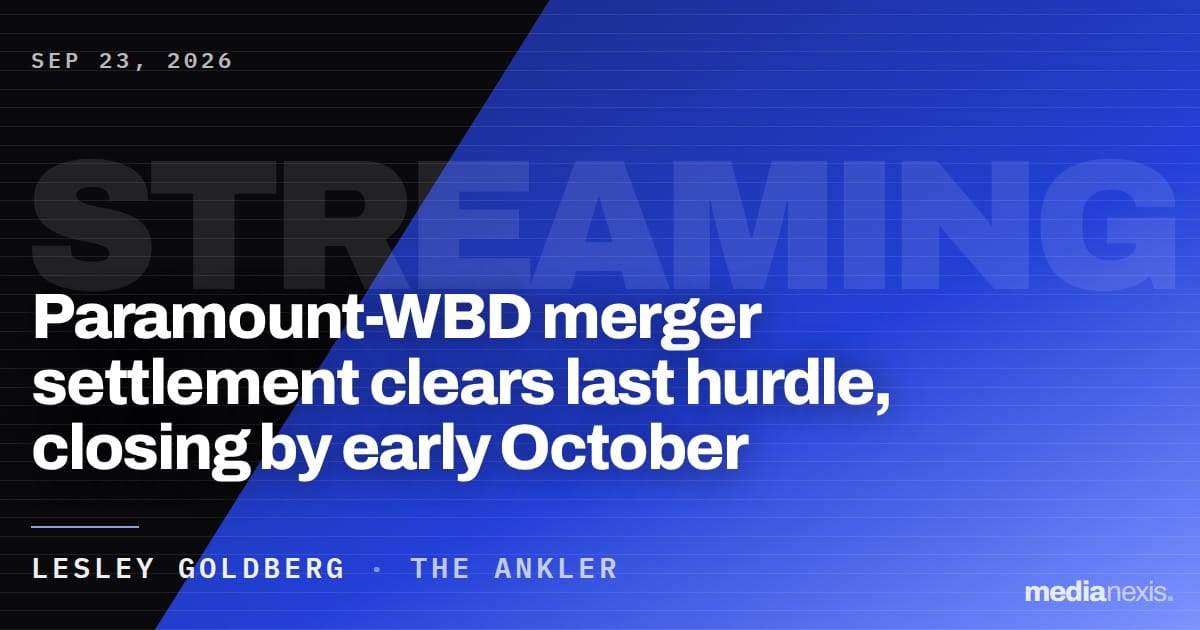
Nine reports in a week, filed under eight story keys the desk has not merged, and they describe one settlement two opposite ways. On September 19 Reuters’ Jody Godoy reported the terms on the table: independent monitoring of CNN and a floor on theatrical releases. Three days later Variety’s Gene Maddaus reported Paramount had settled with 12 state attorneys general, just before a $7 million daily ticking fee was due to start on Oct. 1, with no major divestitures. The Hollywood Reporter’s Rick Porter found Pluto TV locked in at current service and quality levels for five years. Its Carly Thomas reports California took the five-year consent decree rather than go to trial, and TheWrap’s Sharon Waxman reports Rob Bonta gave way once Paramount threatened to leave the state. Then the readings split. The Ankler’s Lesley Goldberg called it a settlement with no structural remedies. The DOJ’s Stanley Woodward, Deadline’s Ted Johnson reports, went further: the only antitrust provisions, he said, require Paramount to honor commitments it had already made. Media War & Peace’s Evan Shapiro read the same decree as court-enforced, with a trustee monitor who reports to the court rather than to management and can trigger liquidation if the terms are broken. Both cannot be the whole story. The one number every reading shares is the $77.2 billion in net debt that Variety’s Todd Spangler reports the combined company carries at close, and a promise to keep Pluto TV running and keep making movies is only as strong as whoever can hold it against that bill. SEP 19 · REUTERS On the table: a CNN monitor and a floor on film releases
SEP 22 · VARIETY Settled before a $7 million daily ticking fee, no major divestitures
SEP 22 · HOLLYWOOD REPORTER Pluto TV kept at current service levels for five years
SEP 23 · HOLLYWOOD REPORTER California folds for a five-year consent decree
SEP 23 · THE ANKLER No structural remedies; Zaslav says closing by early October
SEP 23 · DEADLINE The DOJ: the only antitrust terms are promises already made
SEP 23 · VARIETY $77.2 billion in net debt at close
SEP 25 · THEWRAP Why Bonta caved: the relocation threat
SEP 25 · MEDIA WAR & PEACE The other reading: a trustee who reports to the court
| ||
Six from the desk | ||
|
Measurement
The Measure’s Jon Lafayette reports Chartbeat’s Publisher Playbook found Google search pageviews down 40.2% over the past year, even as total network pageviews held near flat at 31.1 billion a month. The readers did not leave. They stopped arriving from the one source most publishers built their traffic plans around.
Streaming
Deadline’s Jill Goldsmith reports the ad-free Premium tiers take the steepest rise, up 13% to $21.49 a month. It came the same week Disney made Adam Smith sole chairman of direct-to-consumer. Every increase tests the same bet: that leaving costs a subscriber more than staying.
Creators
Marketing Dive’s Sara Karlovitch reports the IAB surveyed 2,200 AI shoppers for its Creator Signal study. The preference is real. The pitch now selling it, creator citation inside AI answers, has not shown it moves a purchase.
Ad-tech
MediaPost’s Wayne Friedman reports Pixalate found smart TVs take 57% of US open CTV programmatic spend against 43% for mobile and tablets, with Amazon’s Fire TV at 30% of the large screen, ahead of Roku’s 18%, Samsung’s 5% and Apple TV’s 4%. The biggest seller on the big screen is a retailer’s platform, and the retail story below runs through the same sets.
Agencies
Marketing Brew’s Jennimai Nguyen reports season 35 has drawn the show’s most advertiser interest ever, Disney Advertising’s John Campbell says, with ad revenue up 5x year over year behind four season-long sponsors and seven custom ones. A 35-season broadcast franchise is outselling the new formats on sponsorship, the oldest deal in television.
Retail media
Adweek’s Lauren Johnson reports Best Buy is selling and measuring ad inventory on Amazon Fire TV, including Insignia, its private-label Fire TV brand, and Modern Retail’s Anna Hensel that it launched Best Buy CTV at its annual retail media showcase. The retailer now owns the shelf, the set and the screen the ad plays on.
| ||
The rest of the week | ||
|
Measurement and ad-tech
Forrester bet recommendation share overtakes impressions · audio plus CTV lifted recall to 65% from 37% · Comscore went inside datafuelX’s forecasting tools · TelevisaUnivision renewed Nielsen anyway · Nielsen cut its public Top 10 lag to two weeks · NFL opening week fell 13% to 19.5 million · betting brands spent $269.8 million on linear TV · tech brands tripled their NFL share of voice · Doug Shapiro on why time spent stopped tracking value · podcasters asked the IAB for new metrics · DoubleVerify put a chat layer on Pinnacle · Google tested ads in AI Mode · Meta opened Muse to developers · ChatGPT ads went inside Shopify and HubSpot · Taboola bought Dianomi for up to $36.1 million · 33 public radio stations became one national buy
Streaming
Wells Fargo cut Netflix to underweight · HSBC followed, on a 7.8% share of US TV time · streamers cut national TV ad spend 29% · being the default service cut churn six-fold · short clips rose to 13% of Netflix’s US catalog · Netflix passed Canal+ in French content spending · Local Now took all 111 Gray stations · Wondery put its podcasts on Freevee · Disney gave streaming to one chairman · Paramount weighed Elon Musk as an equity investor · dealmakers said the merger proves tech has won · ESPN kept Joe Buck for $108 million over six years · North American TV revenue grows about 3% · streaming renewals kept falling · a second Emmys count put Apple at 29
Creators, agencies and retail media
the IAB put creator ad spend past $44 billion · OpenAI’s sponsored ChatGPT posts went from 61 to 141 · Perplexity hired a creator lead at up to $225,000 · Disney signed Like Nastya · Spotify took its partner program to 35 regions · creators took equity instead of fees · Jake Paul’s fund passed $180 million · Kalshi owned NFL TikTok with no sponsorship · creators started pitching AI citations · RedBird valued Puck at $250 million · a federal production credit headed for the House · commercial production moved to Texas, Florida and Georgia · Sam’s Club claimed 94% accuracy on a P&G test · Seven.One folded retail data into Joyn · retail networks pitched brand budgets on thin proof · eMarketer kept in-store retail media under 1% through 2028
| ||
|
Drafted from the week’s published signals, edited by humans. Every linked story carries its full source trail on fabric-media.ghost.io.
medianexis · A record of truth, published by humans · The Signal |
