| medianexis. |
The Signal · Issue 12 |
|
|
Week of October 29, 2026
The week in the business of media, ads and measurement: what changed and what it costs you.
|
|
|
The lede
Netflix cut its 2026 ad forecast to $2.7 billion, and Google’s search growth slowed to 12% on AI Mode. The new inventory sells for less than the old.
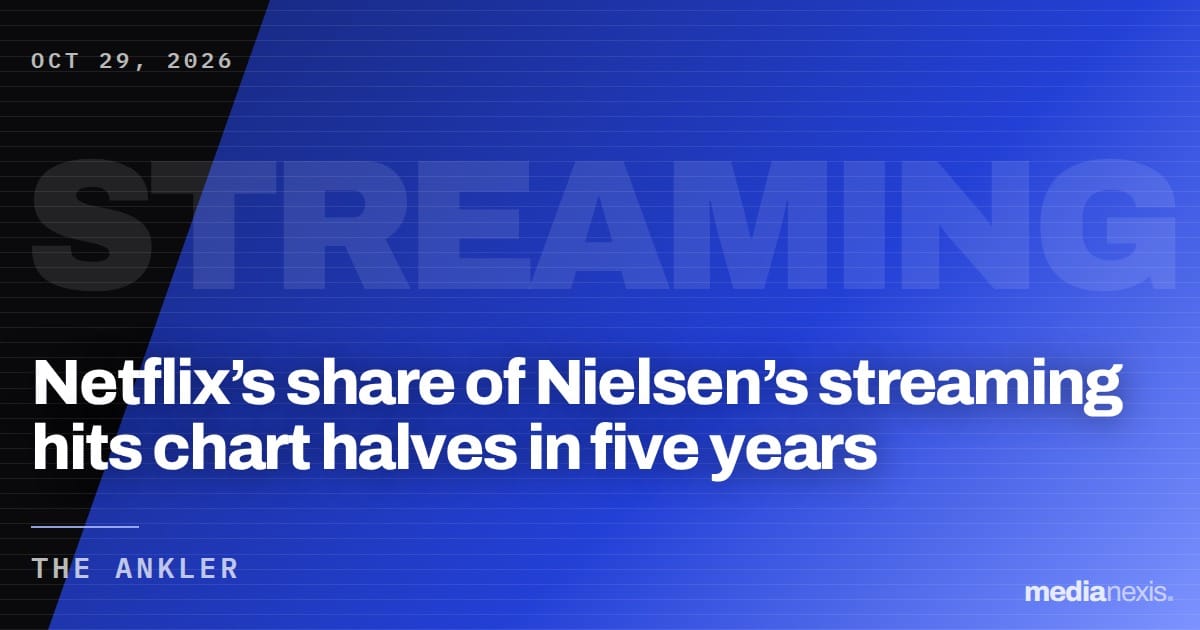
Variety’s Brian Steinberg reports Netflix cut its 2026 ad revenue projection to $2.7 billion from $3 billion, blaming delays in rolling out new ad products while a glut of streaming supply hands buyers leverage on price. It is the same company that, Advanced Television’s Nik Roseveare reports, delivered its Q3 forecast with revenue up 12% to $12.9 billion. Bloomberg’s Lucas Shaw reports customers opening the app on fewer days a month than a couple of years ago, and The Ankler counts Netflix’s share of Nielsen’s weekly originals chart down from 80% of titles in 2021 to 51%. Google had the same quarter in a different key. Adweek’s Kendra Barnett reports Alphabet’s search revenue growth slowing to 12% from 17%, with executives citing AI Mode’s lower ad monetization; TechCrunch’s Lauren Forristal reports Google taking AI Mode ads international anyway, and eMarketer’s Asa Hiken reports it personalizing those ads with signals from Gmail and Photos.
The platforms’ answer is to do more of the work and carry less of the risk. AdExchanger’s Allison Schiff reports Meta rolling out an LLM-based ranking model and an Andromeda that scores more than a billion ads per second; Adweek’s Trishla Ostwal reports its new terms make advertisers responsible when its AI alters their ads, and Digiday’s Sara Guaglione reports Meta pushing those terms to November 20 after publisher trade bodies objected. The Verge’s Emma Roth reports OpenAI taking ChatGPT ads to 26 more countries, and AdExchanger reports it applying creative enhancements to existing ads from October 30 unless advertisers opt out. Underneath, the pipes still cannot say what ran: The Measure’s Jon Lafayette reports Wurl finding 89% of CTV ad requests carry no usable program name, and Next in Media’s Mike Shields reports Skydance weighing whether to drop FreeWheel and hand its streaming ad tech to Google.
So the money went where the count is surest. MediaPost’s Wayne Friedman reports Comscore’s new Score Report giving broadcast 43.2% of TV and streaming ad-exposure time, cable 34.5% and streaming 22.3%, and TVREV’s Jason Damata reports iSpot finding streaming at revenue parity with linear on far fewer impressions. Sports Business Journal’s Austin Karp reports Thursday Night Football averaging 17.7 million viewers on Prime Video, up 12%, Adweek’s Bill Bradley reports its advertisers up 6%, and Digiday’s Sam Bradley reports NBA inventory all but sold out across Peacock, Amazon and Disney. MediaPost’s Joe Mandese reports local broadcast holding 50% of the midterm money spent so far against CTV’s 21%. The agencies split the same way: Campaign’s Elena Lewis reports Omnicom’s organic growth at 7.2%, while WPP is still shrinking.
What it costs you: a seller that cuts its own forecast has told you which way the price is going. Bring Netflix’s $2.7 billion into the upfront, and ask for the Pixel’s conversion data as part of the deal rather than as an add-on. And decide now whether a machine edits your creative: OpenAI’s enhancements are on unless you opt out, and Meta’s new terms put whatever its AI makes on you.
|
One big story |
 |
|
25 reports · 15 outlets · October 11 – 29
Netflix made its quarter, then cut its own ad forecast.
The quarter held and the outlook did not. Advanced Television’s Nik Roseveare reports revenue up 12% to $12.9 billion at a 34.6% operating margin, on forecast; Sherwood reports the shareholder letter mentioning India six times, double its US references, with the stock falling on a weak Q4 outlook. Then Variety’s Brian Steinberg reports the 2026 ad revenue projection cut to $2.7 billion from $3 billion, on delays to new ad products. That is the number the Pixel and The Trade Desk, announced the morning of the earnings, now have to move.
The engagement evidence ran the other way. Bloomberg’s Lucas Shaw reports customers opening the app on fewer days a month, tracked internally as qualified play days, and The Ankler reads the fall from 80% to 51% of Nielsen’s originals chart as the likeliest reason Bela Bajaria was fired. Variety’s Selome Hailu reports Nobody Wants This opening its third season to 6.2 million views, against 10.3 million for its first. Deadline’s Dade Hayes reports Reed Hastings telling Kara Swisher the answer to YouTube is more and better shows. Bloomberg reports the shakeup widening, with David Fincher out; Deadline reports the co-CEOs holding a town hall the day after the cuts; and The Ankler’s Richard Rushfield is already handicapping who runs film after Dan Lin.
Two retreats sit beside the cuts. The Verge’s Jay Peters reports, citing Puck, Netflix withdrawing a $500 million offer for Xbox adaptation rights after Microsoft countered at $800 million, and Simon Owens flags Business Insider’s report that Netflix may be cooling on video podcasts in the same week Variety reports it hiring Apple’s Steve Wilson to buy more of them. Two weeks ago the cuts were the story, and last week the tools. Now it is the price, and the company that set the target has moved it.
|
Six from the desk |
Measurement
The Measure reports Extreme Reach CEO John Batter saying the industry has no creative ID structure to connect ad variants to their masters, track rights compliance by region or link production cost to media outcome. AI is making variants faster than anyone can label them, so every tool that multiplies the work widens the gap.
Streaming
The Wall Street Journal’s Patrick Coffee reports automakers cutting national brand ads on linear TV for targeted streaming and regional sales spots, with auto’s share of ad spend set to fall below 10% this year from 13% a decade ago. Prime time is losing one of its oldest anchors to the formats a buyer can aim.
Creators
Variety’s Todd Spangler reports Instagram testing videos up to 90 minutes and expanding to Apple TV as it positions itself as a bigger YouTube rival, still with no ad-revenue share for creators. It is asking for YouTube’s length without offering YouTube’s deal.
Ad-tech
Digiday’s Kimeko McCoy and Tim Peterson report independent agencies’ long-running complaints about DSP fees and reseller costs, with The Trade Desk singled out as the main target. The argument has moved from what the tool costs to whether to buy it.
Agencies
Adweek’s Alison Weissbrot reports WPP’s Q3 revenue less pass-through costs down 2.1% to $3.2 billion, narrower than Q2’s 2.8% decline, with WPP Media returning to 0.3% growth for the first time in six quarters. Set against Omnicom’s 7.2%, the two largest holdcos are now moving in opposite directions.
Retail media
eMarketer’s Rachel Wolff reports Instacart retreating from its in-store smart cart hardware, the devices meant to anchor the in-store ad and data business it built to compete with Amazon and Walmart. In-store is the frontier everyone names, and one of the few companies with hardware in the aisle just stepped back.
|
The rest of the week |
Agencies and retail media
|
Drafted from the week’s published signals, edited by humans. Every linked story carries its full source trail on medianexis.com.
medianexis · A record of truth, published by humans · The Signal
|
|
